
Building the wrong thing faster
The 2026 data on speed, trust, and how to close the gap

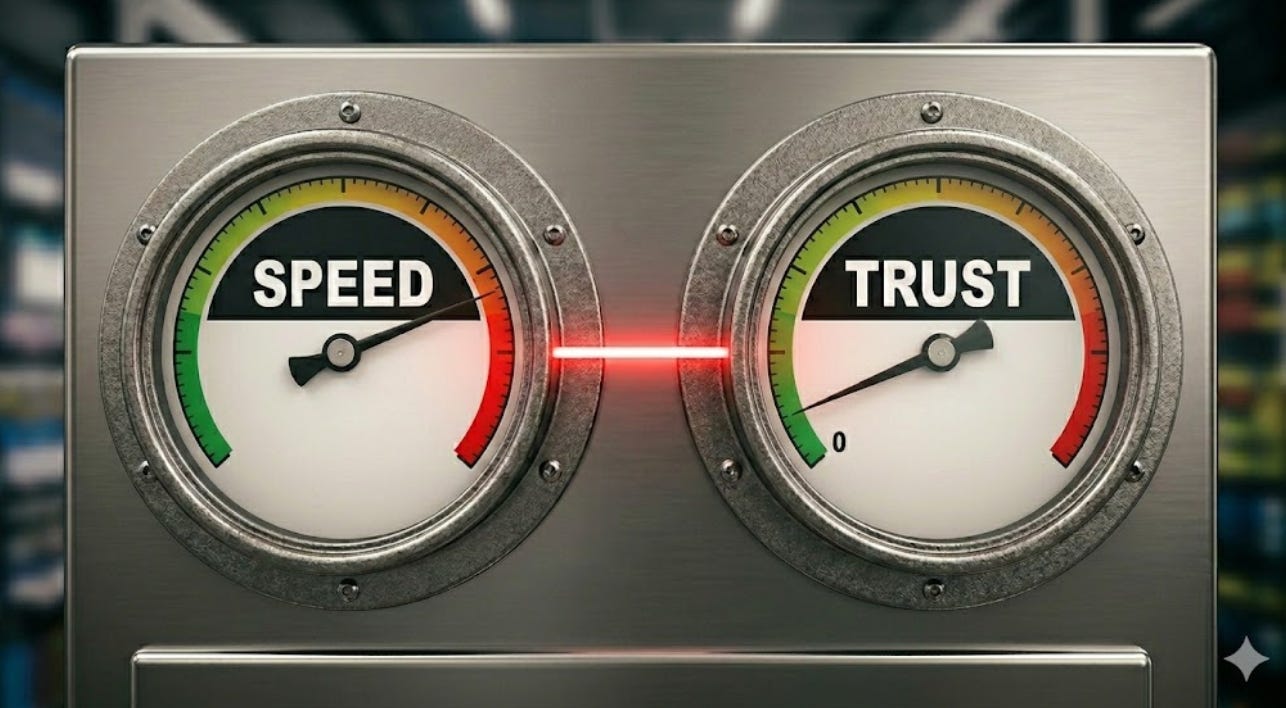
The tension between speed and trust has always been around. AI exacerbated it.
Thank you dbt Labs for sponsoring this edition. I've been writing a lot about trust in data, and this sponsorship came in at the right time. More on that below.
Imagine this scenario: You have two teams that want to measure patient’s readmissions. Same hospital system and same patients.
Operations says readmissions are down 8%. Clinical Quality says they’re up 12%.
Both built their pipelines fast, and both logic was sound. Both were technically correct.
Here was the issue: Operations only considered as “readmissions” patients who came back to their own facility. Their question: do we have enough resources for patients coming back here?
Clinical Quality considered as “readmissions” patients who were readmitted across the entire network. Their question: what do patient outcomes look like overall?
Same word and two different questions. Nobody stopped to align before the first query ran. And while both teams debated which number was right, patients kept coming back through those doors.
That’s not a speed problem. The pipelines ran fine and they were built fast. It’s a trust problem that didn’t start in the data. It started in the conversation nobody had before anything was built.
The AI and Data challenge of 2026:
The 2026 State of Analytics Engineering Report by dbt Labs found that 83% of organizations now say trust in data is their #1 priority. That’s up 17 points in one year. Speed rose too, 21 points. What isn’t keeping pace: the alignment work that makes speed safe to act on.
71% of data teams are worried about hallucinated or incorrect data reaching stakeholders. IMHO, hallucinations aren’t the only way wrong data reaches a stakeholder. Sometimes it’s two teams building fast in opposite directions, using the same word to mean two different things.
Check the full report HERE
So what do we do with this?
AI accelerated execution. It did not replace the judgment that decides what is worth executing in the first place.
That judgment lives in the conversation before the first prompt, before the first query. It’s built from something AI does not have: time spent inside the problem, understanding what the stakeholder actually does with the answer.
Before you build anything, ask:
What decision is this supporting?
Who is in this scope and who isn’t?
What would make this answer wrong?
Those three questions won’t slow you down. They’re what makes speed trustworthy.
What does it mean for the data professional?
The work is moving upstream. Not because the technical skills matter less, but because AI absorbed the part that used to take most of our time.
The query gets written faster. The pipeline gets built faster. The answers are right there for the end user, faster than ever. But do we trust them?
So yes, learn the tools. Use AI to move faster. But don’t stop there.
The data professionals who will matter most in the next few years are the ones who know which questions to ask before any query exists. They sit with a stakeholder and translate what they actually need. They understand that a definition is a business decision encoded in SQL.
Speed was never the problem. Building the wrong thing faster is.
Thais
Perhaps the first question isn't whether readmissions are up or down. It's how "readmission" is defined and measured.
Once two teams answer that question differently, the data will inevitably tell two different stories.
Perhaps the lesson is that trust doesn't begin with data. It begins with shared intent.
Both teams were technically correct. They were simply answering different questions. Speed didn't create the problem. It exposed it.